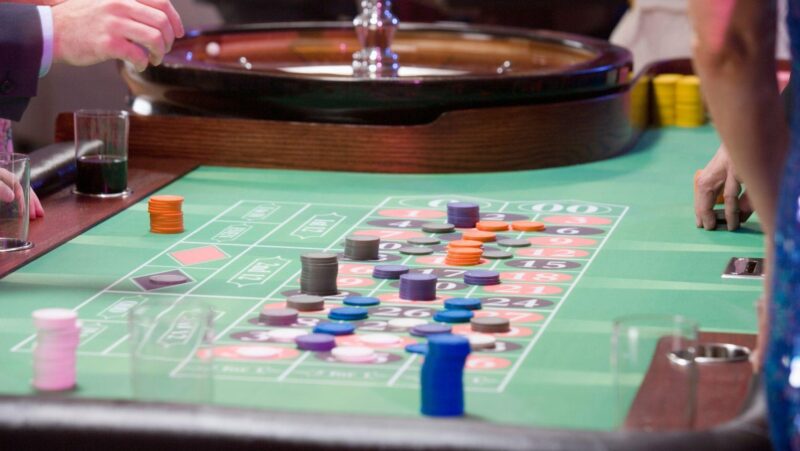
Strip away the felt and the croupier and what remains is a genuinely difficult engineering brief: stream video to tens of thousands of concurrent viewers, keep every one of them within a second of real time, accept structured input from all of them during a window that must close simultaneously, and reconcile the physical outcome of an event with a database.
Nobody set out to build that. The industry arrived at it because a table game rendered in software felt like software, and the fix turned out to be considerably harder than the problem.
The result is live casino, a category that barely existed fifteen years ago and now anchors the lobby of practically every online casino trading today. Comparison coverage of online casinos lists it as a standard tier alongside slots and table games (source: https://www.newgamenetwork.com/casinos), which rather understates the difference underneath. A slot is software. A live casino table is a television facility with a settlement engine bolted to it, and the infrastructure has more in common with sports broadcasting than with anything else in gaming.
The Latency Constraint Is the Whole Design
Start here, because every other decision follows from it.
Ordinary video streaming tolerates buffering. A viewer several seconds behind live is a viewer having a fine time. The standard delivery protocols are built around that tolerance, chunking video into segments and accepting a delay of anywhere from six to thirty seconds in exchange for reliability.
None of that works when the audience has to act. If a player sees a card three seconds after another player, and both are still permitted to bet, the game is broken. Not degraded, broken, because one participant has information the other does not.
So live dealer operates on sub-second delivery and enforces synchronisation across every connected session. That constraint rules out the standard streaming stack and pushes operators toward low-latency protocols and dedicated distribution, which is expensive and is the reason a small number of suppliers dominate the category.
The betting window then has to close identically everywhere. Not approximately, identically, and the server decides rather than the client, because a client that decides is a client that can be manipulated.
Optical Recognition Replaced the Human Typing
The second engineering problem is turning a physical event into game state.
Early implementations had a person watching and entering results, which is slow, error-prone and impossible to audit properly. The systems now use optical card recognition, with cameras reading each card as it leaves the shoe and feeding the value directly into the game engine.
That has consequences beyond speed.
It creates a verifiable record. The recognised value is logged with a timestamp and can be checked against the video afterwards, which means a disputed hand is resolvable rather than a matter of testimony.
It changes the physical design. Shoes are built with recognition windows. Table surfaces are marked to position cards where cameras expect them. The furniture is instrumentation.
It shifts the failure mode. The old failure was a person mistyping. The new failure is a misread, which is rarer and more systematic, and requires a defined recovery procedure that pauses the round rather than resolving it wrongly.
Roulette solved the equivalent problem differently, with wheels reporting their own results through sensors rather than a camera reading the pocket.
The Studios Are Television Facilities
Anyone expecting a casino floor with a webcam is a decade out of date.
These are purpose-built studios, engineered around camera positions rather than player positions. Multiple angles per table, controlled and consistent lighting, acoustic treatment, and dealers who are trained on presentation as much as on procedure because they are on camera continuously for a shift.
The scale is the part that surprises people. Major suppliers run facilities holding hundreds of tables across multiple countries, staffed around the clock, in several languages, with dedicated environments for particular markets.
Which makes the economics closer to a broadcaster’s than an operator’s. Fixed costs are enormous and largely independent of how many people are playing, so utilisation is everything, and the way to raise utilisation is to serve many operators from the same table.
That is the industry’s actual structure. The table you are watching is very likely being watched simultaneously by players who arrived through a dozen different brands, each running its own interface over a shared feed.
What Actually Reaches Your Screen
Worth separating the layers, because they are supplied by different parties.
The video comes from the studio, distributed through a low-latency network.
The game state arrives separately as structured data. Card values, wheel results, timer position, betting status. This is the authoritative channel, and the video is presentation.
The interface is rendered locally by the operator’s client, drawing the betting layout, your balance and the controls over the video.
That separation matters. Your bet is validated against the game state, not against what your screen displays, which is why a stalled video feed does not mean a stalled game and why a disconnect at the wrong moment resolves according to the server’s record.
It also explains why the same table looks different across operators. The feed is shared, the presentation layer is not.
Why It Won
Three reasons, and only one of them is about atmosphere.
It solved a trust problem that certification could not. A player watching a physical card leave a physical shoe does not need to reason about random number generation. The verification is visual and immediate, and no amount of published certification produces the same intuitive confidence.
It transferred a format rather than inventing one. Blackjack, roulette and baccarat already had rules, pacing and an established audience. The engineering task was delivery, not design, which is a much better position to start from.
It fits the device. A dealer talking to camera works on a phone in a way a rendered table does not, and the shared feed means a small audience for a niche variant is still viable because it is aggregated across every operator carrying it.
The Part Worth Watching
The interesting engineering question now is what happens as the format extends.
Game show style products, with augmented graphics layered over a live presenter, are already the fastest-growing segment, and they push the technical requirements further. More real-time compositing, tighter synchronisation, and outcome mechanisms that are neither cards nor a wheel.
Each step makes the underlying system less like a casino and more like a live production company with a settlement engine attached. Which, if you look at what these facilities actually contain, is a reasonable description of what already exists.
More on the systems behind modern platforms in the technology coverage archive.